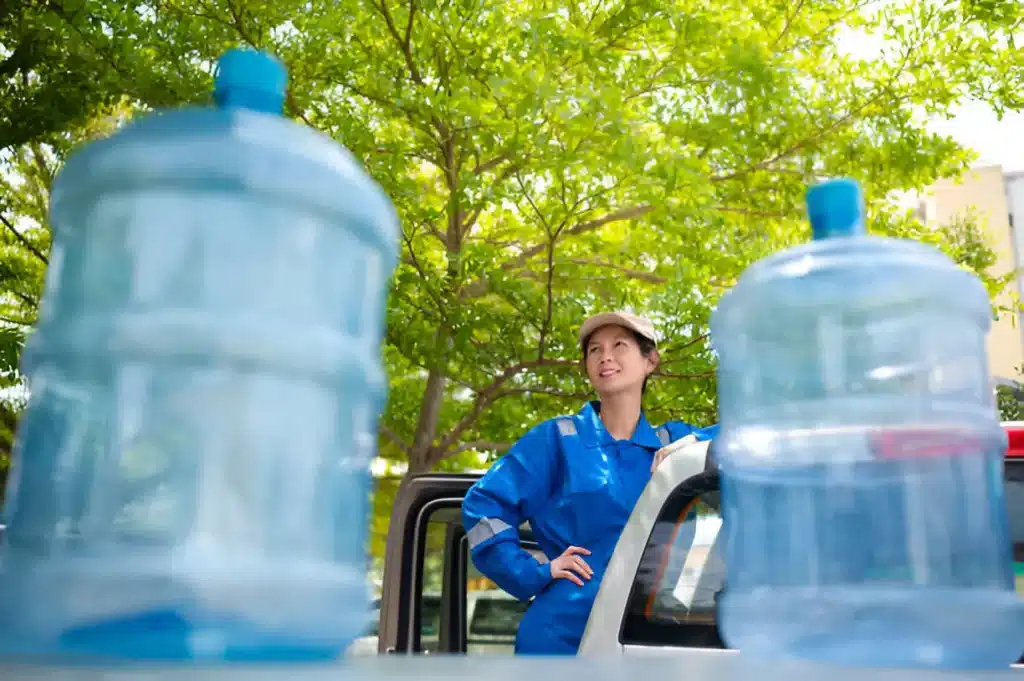
A crew working outdoors in Tampa heat needs roughly a quart of water per person per hour — which means a ten-person crew can go through three to four 5-gallon bottles in a single shift. Most Tampa businesses discover that number the hard way, somewhere around the second week of July. This guide covers the volume math, the equipment choice, and how water cooler rental in Tampa fits crews, shops, warehouses, and offices that run hot.
Start With the Volume, Not the Equipment
Most businesses shop for a cooler first and figure out consumption later. Reverse that.
NIOSH and OSHA guidance for people working in heat is specific: about 8 ounces every 15 to 20 minutes, which comes to roughly 24 to 32 ounces per hour. Over an eight-hour shift, that’s around two gallons per worker. Run that math across your headcount and the picture changes fast.
| Crew size | Full shift in heat | 5-gallon bottles/day | Bottles/week (5 days) |
| 3 workers | ~6 gallons | ~1.2 | 6 |
| 6 workers | ~12 gallons | ~2.4 | 12 |
| 10 workers | ~20 gallons | ~4 | 20 |
| 20 workers | ~40 gallons | ~8 | 40 |
Two caveats keep this honest. Not every worker draws all of their water from your cooler — plenty bring their own. And indoor crews in conditioned space will use meaningfully less. But if you’ve been ordering for a warehouse or a job site based on what the office drinks, you’re underordering by a wide margin.
There’s also a ceiling worth posting on the wall: workers shouldn’t exceed about 48 ounces in a single hour, or roughly 12 quarts in 24 hours. Drinking too much plain water too fast dilutes blood sodium and creates a different emergency. Steady intake beats volume.
Where Florida Law Leaves Tampa Employers
This part matters because it’s changed recently and a lot of business owners have outdated information.
Florida has no state-level heat illness prevention standard. In 2024, HB 433 preempted local governments from creating their own — which is why Miami-Dade’s proposed heat ordinance was withdrawn, and why no Hillsborough or Pinellas ordinance is coming.
At the federal level, OSHA proposed a Heat Injury and Illness Prevention standard in August 2024. Public hearings concluded in 2025, but the rule has not been finalized and has no announced target date. That said, OSHA still enforces heat hazards under the General Duty Clause, which requires employers to provide a workplace free from recognized hazards likely to cause serious harm. Heat is a recognized hazard, and OSHA has issued heat-related citations to Florida employers.
The practical takeaway: nobody is going to hand you a checklist, but “we didn’t have a rule to follow” isn’t a defense. Cool water, accessible near the work, in sufficient quantity for the shift, is the baseline OSHA has communicated for years — and it’s also just how you keep people from going down at 2 p.m. (This is general information, not legal advice — talk to your safety consultant or counsel about your specific obligations.)
Choosing the Right Setup for Your Space
Not every location needs the same thing, and this is where a lot of money gets wasted.
Bottom-load dispensers — offices, breakrooms, gyms
The bottle sits inside the cabinet, so nobody has to hoist 42 pounds overhead. Hot and cold taps on demand. This is the right answer for any indoor space with an outlet and staff who aren’t wearing work gloves. If you’re outfitting a Westshore office or a Carrollwood gym, this is the default.
Stainless steel units — client-facing spaces
Same function, better appearance, easier to keep clean in a space where the cooler is visible to customers. Worth it in showrooms, dental offices, salons, and lobbies.
Manual pumps and racks — job sites and unpowered spaces
A job site trailer, a bay in an auto shop, a construction site with no reliable outlet — none of these need an electric dispenser. A hand or electric pump on a bottle plus a rack gets water where the crew is for a fraction of the cost. Pair it with a cooler of ice and you’ve solved the “cool water” part without running an extension cord across a work zone.
You can see the full range of dispensers, pumps, and racks here. For most Tampa businesses the answer is a mix: a proper dispenser in the office, pumps and racks wherever the actual work happens.
Where This Bites Hardest in Tampa Bay
Some workplaces feel a Tampa July far more than others.
Warehouses and distribution. Uncooled warehouse space in Plant City, Brandon, and along the I-4 corridor can run hotter inside than the outdoor air by mid-afternoon. Indoor doesn’t mean cool, and OSHA’s proposed standard explicitly covered indoor settings.
Trades and outdoor crews. Roofers, landscapers, concrete, HVAC installers, utility work. These crews are the textbook case for the two-gallon-per-worker number, and they’re also the hardest to keep supplied because the work location moves.
Auto shops and industrial bays. Roll-up doors open, engines running, no AC. The heat index inside a service bay can exceed what’s happening in the parking lot.
Marine and dock operations. Sun reflecting off the water in Port Tampa Bay adds radiant load on top of ambient heat.
Restaurants and commercial kitchens. Line cooks in July are working a heat problem all their own, and it rarely gets counted as one.
If your business falls into any of these, your July order should not look like your February order. We cover commercial water delivery across Tampa Bay here, including offices, gyms, and multi-location accounts.
Setting a Schedule That Doesn’t Run Dry in August
The most common failure isn’t ordering too little overall — it’s ordering the same amount year-round and running out during the exact week it matters most.
Three things fix it:
- Track one week honestly. Count bottles emptied Monday through Friday during a genuinely hot week. That’s your real baseline, not your estimate.
- Build in 20% margin for June through September. Heat waves, extra crew, an unexpected job — you want the buffer sitting in the corner, not on a delivery truck two days out.
- Keep the schedule flexible. AguaPura delivers on a four-week cycle with no contract and no bottle deposit, so scaling a summer order up and a winter order back down is a phone call, not a contract amendment.
If you’re comparing local delivery against a national account, we covered the operational differences separately. [INTERNAL LINK: link to “Why Tampa Businesses Are Switching from National Water Brands to Local Delivery” blog post]
What’s In the Bottle
AguaPura water goes through an 8-step purification process including reverse osmosis and UV sterilization, removing up to 99.9% of contaminants, and it’s bottled locally in Tampa Bay. For a crew that’s going to drink two gallons of it a day, taste isn’t a luxury detail — water people actually want to drink is water they actually drink. See the purified water product details here.
Cost depends on the dispenser type and how many bottles your team uses. AguaPura charges no contract fees and no bottle deposits — you pay for the water and the dispenser you select. A small office typically needs one dispenser and a handful of bottles per cycle; outdoor crews need far more water and often simpler pump setups instead.
About one quart per hour of work in heat, following NIOSH and OSHA guidance of 8 ounces every 15 to 20 minutes. Over an eight-hour shift that’s roughly two gallons per worker. A ten-person crew should plan on three to four 5-gallon bottles per day in peak summer.
Florida has no state heat standard, and HB 433 blocked local governments from creating one. OSHA has not finalized its proposed federal heat rule, but it enforces heat hazards under the General Duty Clause, which requires employers to address recognized hazards. Providing accessible cool water remains the expected baseline.
Yes. AguaPura delivers 5-gallon bottles to job sites, trailers, warehouses, and shops across Tampa, Clearwater, St. Petersburg, Brandon, Riverview, and Wesley Chapel. Sites without power typically use a manual or battery pump and a bottle rack rather than an electric dispenser.
No. Many Tampa businesses use a simple pump on the bottle, especially on job sites. Dispensers with hot and cold taps make more sense in offices, breakrooms, and customer-facing spaces where staff want instant cold water throughout the day.
Get Your Summer Order Right Before the Next Heat Wave
August in Tampa is not the month to discover your cooler math was off. If you’re running a crew, a shop, a warehouse, or an office anywhere in Tampa Bay, the fix takes about ten minutes: count what you actually use in a hot week, add margin, and set the schedule.
Check whether we deliver to your business address, or take a look at our commercial water delivery options to figure out the right dispenser and bottle count. No contract, no deposit — if your needs change in October, so does your order.